Poster Presentation on Teen Helpline for LGBTQ+ Youth
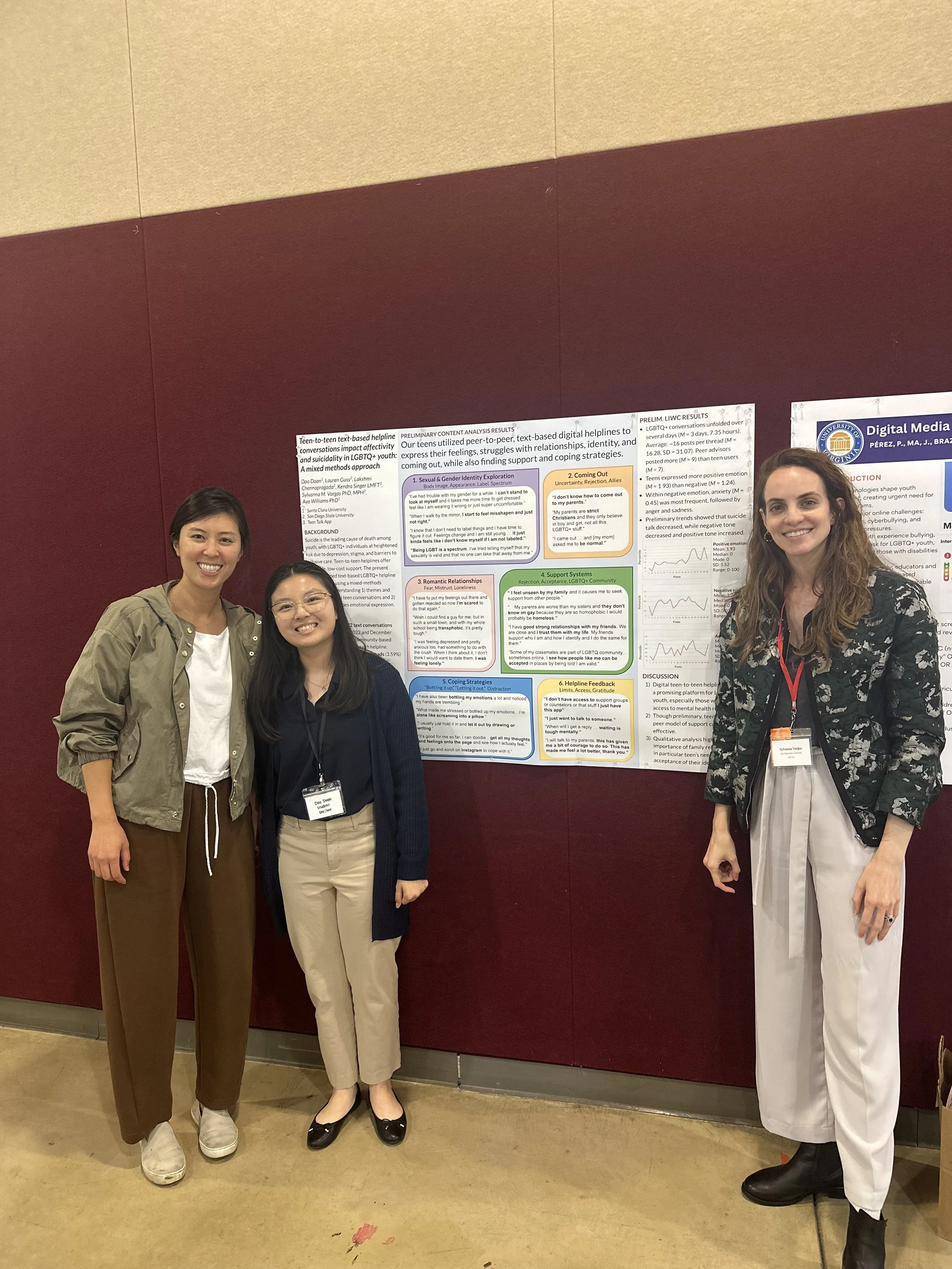
We are thrilled to celebrate our lab member Dao Doan for presenting her poster, “Teen-to-Teen Text-Based Helpline Conversations Impact Affectivity and Suicidality in LGBTQ+ Youth: A Mixed Methods Approach,” at the Digital Mental Health and LGBTQ+ Youth: Bridging Research Industry, and Clinical Care conference held at Santa Clara University.
Dao’s research, conducted in collaboration with Santa Clara University, San Diego State University (PI: Dra. Sylvanna Vargas), and Teen Talk App, shines a compassionate and data-driven light on how digital peer-to-peer helplines serve as vital lifelines for LGBTQ+ teens.
Understanding the Voices Behind the Texts
Using 1,672 text conversations from a community-based mental health helpline between 2022 and 2024, Dao and her team analyzed 60 threads (3.6%) focused on LGBTQ+ youth. Through mixed methods—combining qualitative content analysis and linguistic inquiry (LIWC)—the study uncovered powerful patterns in how teens express emotion, seek belonging, and find hope through text.
“I’ve had trouble with my gender for a while… I can’t stand to look at myself,”
one teen shared.“I feel unseen by my family,”
another teen shared.“I will talk to my parents, this [helpline] has given me a bit of courage to do so,”
another concluded—a reminder that empathy through words can heal.
Key Findings
Conversations lasted an average of three days, showing how sustained text-based conversation might support emotional safety.
Teens expressed more positive than negative emotion overall.
Suicidal language decreased as conversations progressed—highlighting the potential impact of peer support.
Major themes included:
Sexual & Gender Identity Exploration
Coming Out
Romantic Relationships
Support Systems
Coping Strategies
Helpline Feedback
Why It Matters
Dao’s work underscores the transformative potential of digital empathy through words. For many LGBTQ+ youth facing stigma, family rejection, or isolation, online teen-to-teen helplines may be one accessible space for authentic connection.
Her findings also reaffirm the power of peer models in mental health support — suggesting that youth-led, text-based systems can complement traditional therapy and help bridge gaps in care for marginalized communities.
A Huge Congratulations!
We are incredibly proud of Dao for her thoughtful and courageous contribution to mental health research. Her work advances our understanding of how language, empathy, and technology intersect to support vulnerable youth — and reminds us that even small conversations can change lives.