Poster Presentation on Language-Dependent Expression of Anxiety and Depression Symptoms in Japanese-English Bilinguals
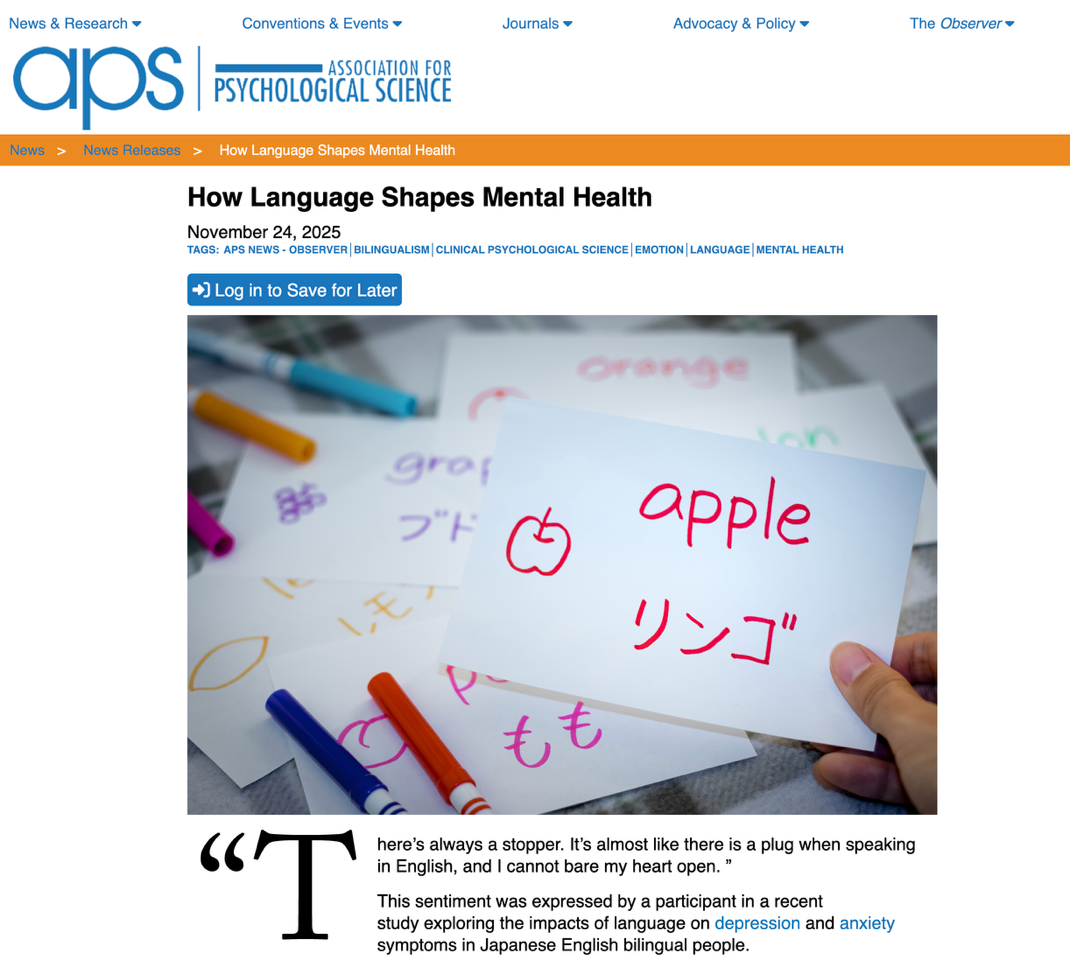
We are excited to highlight the poster presentation by Emily Sakai and colleagues, titled “Language-Dependent Expression of Anxiety and Depression Symptoms in Japanese–English Bilinguals.” Originally scheduled for presentation at Association for Behavioral and Cognitive Therapies (ABCT) on November 21, 2025 the same paper was recently featured on the Observer.
This study brings critical attention to how bilingual individuals may report mental-health symptoms differently depending on the language used, with important implications for culturally responsive clinical care.
Understanding Language and Mental-Health Expression
In this study, 120 Japanese–English bilingual adults completed standardized anxiety (STAI) and depression (BDI-II) assessments in both Japanese (L1) and English (L2), with testing counterbalanced across two days.
The results revealed striking patterns of language-dependent symptom expression. Across measures, participants reported:
Higher anxiety symptoms in Japanese than in English
Greater cognitive symptoms of depression in Japanese
Significantly higher endorsement of suicidal thoughts in Japanese
These findings suggest that emotional and psychological experiences may be more accessible, automatic, and intense in one’s first language—a crucial consideration for mental health screening and clinical care.
Voices Behind the Data
To deepen understanding beyond the numbers, the research team conducted qualitative interviews with participants who endorsed suicidal thoughts. Through careful content analysis, five overarching themes emerged, illustrating:
Difficulty fully expressing distress in a second language
Cultural forms of emotional expression
Complex bicultural identities
Barriers to seeking mental health services
The emotional consequences of language mismatch in clinical settings
Participant narratives revealed how language can either constrain or unlock emotional truth, especially in high-stakes contexts such as suicide risk assessment.
Why It Matters
This research highlights a powerful yet often overlooked reality: language is not just a communication tool—it shapes emotional access, identity, and clinical truth. For bilingual individuals, being assessed in only one language may lead to under-detection of distress, misinterpretation of symptoms, and missed opportunities for early intervention.
The findings carry major implications for:
Equitable mental health assessment
Suicide risk screening in Asian and Asian American communities
Culturally and linguistically responsive clinical practice
Training of bilingual and multicultural clinicians
By demonstrating how psychological symptoms shift across languages, this work strongly supports the need for multilingual assessment models in mental healthcare.